
“Dear me”: living under the constraints of societal expectations and norms
TLÜ eriväljaanne 2026Introduction
There are experiences that shape us long before we learn to name them. They live in daily interactions, social roles, and the quiet assumptions about what our futures should look like. Because of this, societal expectations are not always felt as external rules, but rather as something deeply personal, embedded in how we think and feel about ourselves. “Dear me” is a small-scale feminist research and creative project that explores these experiences through personal storytelling. By inviting participants to write anonymous letters to their younger, present, or future selves, the project aimed to create space for personal reflection on moments that might have otherwise never been spoken. The received letters are not treated as isolated occurrences, but as part of a broader effort to understand how societal expectations and norms are experienced on personal levels.
At its core, the project stems from the idea that personal narratives can reveal patterns and depth that are difficult to capture through traditional, quantitative approaches. Experiences of identity, societal pressure and expectations can often be normalized and internalized which makes it harder to recognize them as a part of something bigger, systematic. By collecting and thematically analysing these individual narratives, the project seeks to trace connections between individual lived experiences and the rigid structures placed on us on a larger scale.
This project lies at the intersection of research and creative practice. Alongside a qualitative thematic analysis of the collected letters, selected excerpts are presented as examples, forming an archive of personal stories. Individual voices are preserved and contextualized, rather than reduced to data. Through this, the project aims to give the letters space to be read, recognized, and united. The “Dear me” project asks what becomes visible when given the chance to reflect honestly and anonymously, and what these reflections might tell us about the systems we live in. By bringing together individual stories and collective patterns, the project contributes to an ongoing feminist conversation on how deep societal structures are woven deep into the fabric of everyday life and the personal realm of individuals. The first part of this paper outlines the theoretical framework of our project, conceptualising our project’s aim, its importance, and role in contributing to the feminist discourse. The second part presents the output of our project: selected excerpts from letters demonstrating the emerged themes alongside our composed reflective commentary based off of the stories shared with us, serving as an archive of voices beside longer excerpts published in the magazine.
Theoretical Framework
Mediated visibility
One main concept that represents and helps to conceptualize our project of exploring societal experiences through personal letters is mediated visibility. It refers to the ways in which experiences become visible, seen, shared, and recognized in various environments such as media. Nowadays social media can be considered as one of the most prominent such environments. Within the feminist discourse, visibility has often been perceived as a way of bringing inequalities and lived experiences evident to the wider public. Although digital networks allow feminism, including the presentation of experienced inequalities, to be communicated to a vast audience, it is shaped by, for example, algorithmic, commercial, and geopolitical constraints (Li, X., 2025).
It relates to the complex economies of visibility discussed in feminist scholar Sarah Banet-Weiser’s work on popular feminism. In a world where visibility has become its own currency and formed an economy of consumers, producers, and other various stakeholders, it becomes necessary to question what kinds of experiences are made visible, and under what conditions. For example in social media environments, this includes considering whether and how certain experiences are shaped to become palatable for a certain audience. In this process, visibility might risk becoming the end goal of feminist expression, rather than a way of engaging with deeper structural issues. (Banet-Weiser, S., 2015)
For our project, this raises important considerations. The aim is not to gather and produce highly curated narratives, but provide a platform where fragments of experiences or even unfinished thoughts can appear without the pressures of public identity. Anonymity, therefore, functions as a way of loosening the demands of the visibility economy. In addition, analytical and research-based commentary alongside the letters provides a deeper structural context, aiming to evoke deeper engagement.
Feminist storytelling
In the concept of feminist storytelling, it emphasizes the importance of sharing personal experiences as a way of understanding both ourselves and the world around us. Stories enable new ways of thinking about the world and ourselves, and if the aim is to achieve gender equality, these stories must be continuously reimagined and retold to reflect more inclusive norms and values (Rodríguez, 2018). Within feminist research, storytelling is used as a methodology to make women’s lives and experiences epistemologically, socially, and politically relevant, allowing for the inclusion of life histories and personal accounts as valid forms of knowledge production. This approach challenges traditional academic practices by encouraging alternative ways of gathering and communicating data.
Storytelling itself is a long-standing and diverse practice of transmitting knowledge, histories, and cultural meanings, expressed through multiple forms such as oral narratives, visual art, writing, film, and other creative mediums (Estés, 2001). Feminist scholars adopt storytelling as a way to challenge dominant and hegemonic narratives that often erase, oversimplify, or universalize women’s experiences. By enabling individuals to tell their own stories in their own words, feminist storytelling creates space for diverse voices and perspectives, expanding the possibilities of how experiences are understood and represented (Woodiwiss et al., 2017).
Furthermore, feminist storytelling is not only a method but also a collaborative and interactive practice that values dialogue, shared reflection, and the interweaving of multiple voices and knowledge. As highlighted by de Nooijer and Sol Cueva (2022), this approach allows for the creation of new meanings and possibilities, where imagination plays a key role in shaping alternative narratives and futures. By moving away from rigid ideas of objectivity and universality in traditional research, feminist storytelling opens up more inclusive, creative, and transformative ways of knowledge production. Ultimately, it serves as both a research tool and a means of social change, enabling individuals to reclaim their narratives and contribute to broader discussions on identity, power, and equality.
Digital Testimony
Our project is rooted in the idea of giving people a space to pause, reflect and share their personal experiences in a way that feels both intimate and meaningful, which connects to the concept of a digital testimony. Digital testimony refers to the use of digital platforms to record, express, and preserve personal narratives, often highlighting voices that are overlooked or marginalized (Couldry, 2010). Through “Dear Me”, participants engage in a reflective process, writing letters to their past selves that capture their emotions, struggles, and growth.
These letters function as testimonies because they transform private experiences into a shared archive of voices. This reflects the idea of testimony as a process of witnessing and interpretation, where personal narratives contribute to broader social understanding. The anonymity of the platform allows participants to speak openly, making the testimonies more authentic and vulnerable. At the same time, the digital format ensures accessibility and reach, enabling diverse perspectives across different intersectional backgrounds to be included.
By highlighting both universal themes and unique experiences, the project demonstrates how digital testimony can foster empathy and collective understanding. It also draws autoethnographic practices, where personal reflection becomes a way to explore cultural and social structures (Ellis, Adams & Bochner, 2011). In this way, the project validates individual struggles while situating them within broader systems of patriarchy, ultimately contributing to awareness and dialogue in contemporary society (Couldry, 2010).
Popular Feminism
Popular feminism (sometimes called “pop feminism”) refers to feminist ideas and identities that circulate widely in mainstream media and everyday culture, often through celebrities, brands, social media, and entertainment rather than activist or academic spaces (Banet‐Weiser et al., 2019). It makes feminism highly visible and “cool,” but also raises questions about depth, politics, and who is included. (Banet‐Weiser et al., 2019; Martínez-Jiménez, 2020).
Popular feminism is characterized by its strong presence in media and culture. It is highly visible and media-driven, appearing in celebrity statements, advertising, television, music, fashion, and social media platforms such as Instagram and Twitter (Gill, 2016; Banet-Weiser et al., 2019). Because of this visibility, feminist ideas often become accessible to wider audiences in simplified and relatable forms.
Another key feature of popular feminism is its positive and “empowering” tone. It often promotes messages of confidence, self-love, and personal success, distancing itself from stereotypes of feminism as negative or confrontational (Gill, 2016; Banet-Weiser et al., 2019). While this framing increases public acceptance of feminist ideas, it can also shift attention away from structural inequalities toward individual self-improvement.
Moreover, another key feature of popular feminism is its positive and “empowering” tone. It often promotes messages of confidence, self-love, and personal success, distancing itself from stereotypes of feminism as negative or confrontational (Gill, 2016; Banet-Weiser et al., 2019). While this framing increases public acceptance of feminist ideas, it can also shift attention away from structural inequalities toward individual self-improvement.
Popular feminism is also closely tied to consumer culture and branding. Feminist messages and identities are frequently commodified through products, influencer content, and marketing campaigns, creating an “economy of visibility” in which being seen as feminist can also function as cultural or commercial value (Banet-Weiser et al., 2019; Jackson, 2020).
This concept is directly relevant to our project because it raises questions about how feminist ideas and personal experiences are made visible and shared. While popular feminism encourages public expression and visibility, these expressions are often shaped by media logic, audience expectations, and the need for recognition.
In contrast, our project moves away from this visibility-driven logic by creating a space where participants can share reflections without the pressure to perform a “public feminist identity.” Through anonymity and personal reflection, we aim to reduce the influence of commodified or curated narratives and instead allow more authentic, fragmented, and private experiences to emerge. In this way, the project critically engages with popular feminism by exploring what feminist expression looks like when it is not shaped by visibility, branding, or audience approval.
Methodology
This project relies on a qualitative and narrative-based approach, collecting anonymous letters in which voluntary participants reflect on their personal experiences of societal expectation. Responses were gathered through a Google Forms questionnaire that gave participants the freedom to share their stories anonymously from the comfort of their homes. The link to the questionnaire was shared on social media and physical information stands around the campus of Tallinn University. All the 12 submissions were analysed using Braun and Clarke’s thematic analysis and its inductive approach to identify recurring themes. The most recurring and impactful themes came to be normalized harm, emotional vulnerability, one’s identity, and the explicit validation from the very expectations.
Our role as researchers was not to quantify or generalise these experiences, but interpret them with care and position them within a wider feminist framework. The aim throughout was to preserve individual voices and not apply strict meaning to words and subjective narratives. Therefore, impactful sentences were picked out from each letter to illustrate the reflective commentary composed by us, the researchers, based on the stories told.
Ethical considerations were central throughout the entire project. Participation was voluntary and completely anonymous, consent was clearly communicated in the beginning of the questionnaire, and narratives were treated as lived experiences and not extractable data. By balancing the research with analytical interpretation and respect for subjectivity, the project situates our research between both the act of listening and feminist responsibility.
Project outcome: Text excerpts and reflective commentary for publication
There are things that become engrained in our life long before anyone explains them to us. Long before we are able to make sense of them or even realize their existence. It is the sheer yet often rigid manuscript for how our life ought to unfold. How to feel, look, and react. What is wrong, what is right, and what is acceptable. How to make discomfort disappear – let it be our own or the others’ around us.
These frameworks do not need to appear as rules or as a checklist hanging on the wall of our bedrooms. They often arrive as atmosphere. In the tone of family conversations; in jokes used to mask pain; in the silence after a traumatic event. They are hidden in beauty standards, subconscious timelines, and in the very flesh of our bodies that the deeper systems like to claim. In the subtly taught assumptions that some are allowed to take, while others have to endure its pain.
The letters gathered here are individual stories from people who want to share and reflect on their own experiences of the quiet, or loud, expectations felt in our society. They navigate through grief, anger, violence, shame, migration, faith, endurance, and tenderness. They are individual testimonies of separate lives, yet they reveal something shared: what feels personal and isolated is often deeply societal.
When reading the letters, several common themes arose: normalized harm, emotional vulnerability, one' s own identity, and validation. Short excerpts picked out from 12 of those anonymous letters all carry an impactful message of those themes. By composing reflective commentaries to elaborate on the specific thoughts, we aim to connect individual narratives into a bigger web of experiences. These are not case studies, but fragments of lived knowledge, published with the intention to unite. Fictitious names were assigned to honor the participants’ lived experiences while maintaining confidentiality.
Normalized harm
There are some forms of harm that arrive so quietly they become difficult to name and recognize. Several letters return to experiences that became clear only much later. Moments of discomfort, inequality, and even violence that felt too ordinary or acceptable to question. Gradually, these reflections begin to raise a fundamental question about how patriarchal and societal expectations normalise harm by settling so deep into everyday life and interactions. What should be avoided and condemned appears as something acceptable.
There is a certain idea of what a victim looks like. – Rowan
There will come a moment when you realize the world does not treat everyone equally, especially women. – Gabi
He was under the assumption that nothing would happen to him. He has no fear of repercussions. – Kai
All the little unspoken rules. – Elia
Several voices ponder on the universal experience of delayed realisation, reflecting on what had long gone unnoticed or thought of as okay. Harm was not always obvious, dramatic, or visible to others, even the person themselves. Instead it creeps quietly in normalised behaviour, unequal treatment, emotional pressure, or assumptions about who is “allowed” to be hurt.
Some of the stories share experiences of sexual assault not being recognized because of the perpetrator’s familiarity; pain being doubted because it did not resemble the usually told stories; hardship being accepted because “it’s just the way things are”. Violence can often be thought of as clearly identifiable, committed by strangers, or leaving behind a singular type of victim. However, real life is less ordered than that. Pain should not need prerequisites.
The letters challenge narrow cultural ideas of victimhood and reveal how it is all embedded in the structures and social dynamics we’re used to. As Elia voiced, “all the little unspoken rules” that seem meaningless, not even worth speaking about out loud, yet which dictate people’s lived experiences and affect the very ways in which we, often silently, go through life.
Emotional vulnerability
If silence begins in normalised harm, many of the letters suggest that it continues through emotional suppression. Participants describe environments where endurance was valued over openness, and where vulnerability became something to dismiss rather than express. As a whole, these reflections bring into light an important consideration of emotional restraint being seen as the embodiment of maturity and strength.
We would make jokes and pretend to move on. – Kai
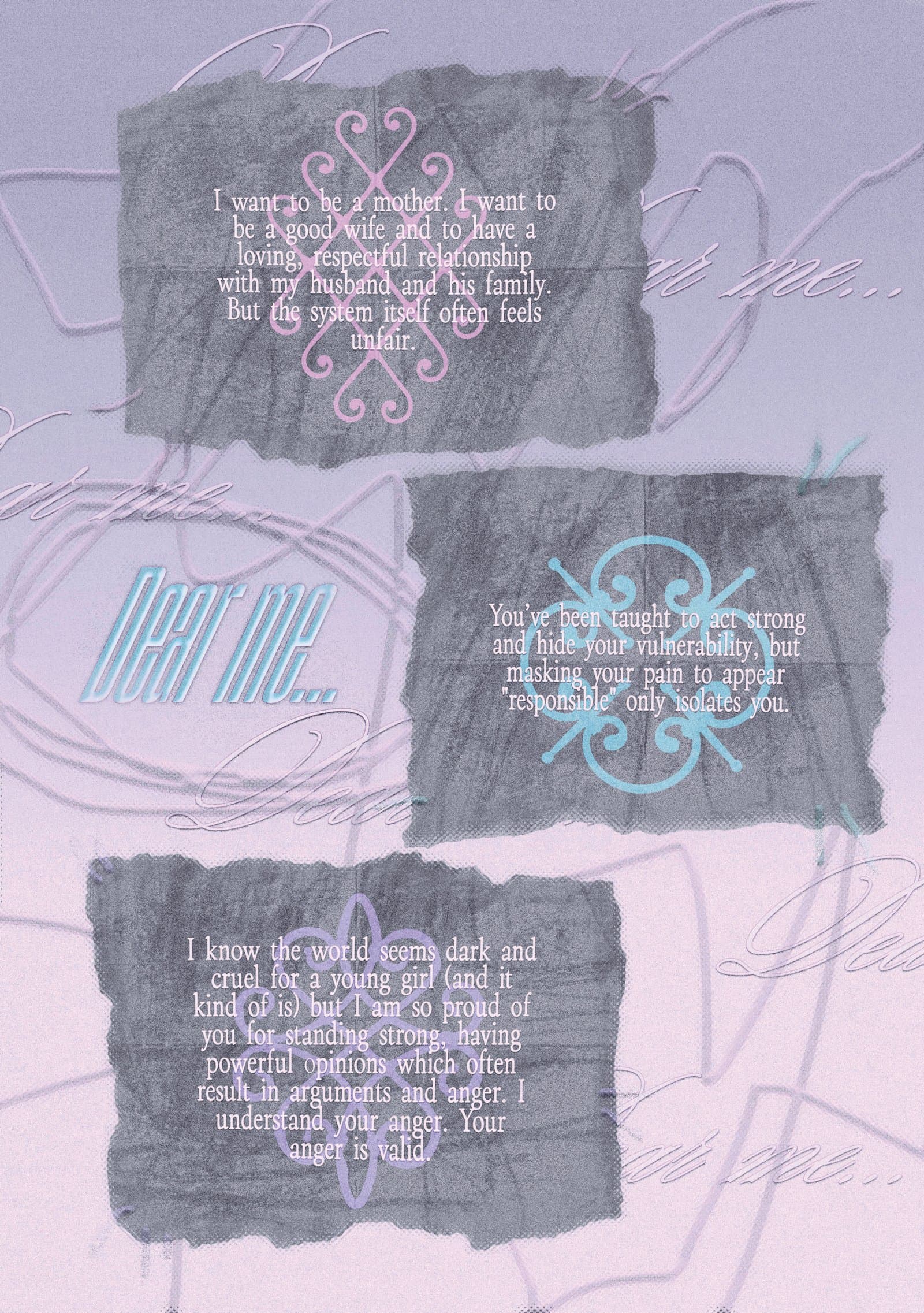
You’ve been taught to act strong and hide your vulnerability, but masking your pain to appear “responsible” only isolates you. – Mika
Your emotions are not wrong. They are not too much or too little. They are exactly what they needed to be. – Rain
If they were punished for their softness, in their eyes, I should be grateful for this tough love that saved me from embarrassing myself later. – Skye
Many letters approach a version of themselves to reflect on a kind of quiet emotional absence they learned to embrace: the lack of guidance, of acknowledgement, of space to sit with difficult feelings. Across friendships and families, discomfort was avoided, and vulnerability replaced with humour or silence. Several of the letters subtly or directly question this version of strength as endurance. What happens when being “fine” becomes more important and normal than being honest?
Emotional experiences are reflected as difficult to deal with because society has made it normalised or even mandatory to hide our true feelings. What is repeated within families or familiar environments begins to feel normal, even when it quietly limits how people express themselves.
Over time, this shapes how emotions are carried; kept inward, carefully managed and rarely spoken in full. What is suppressed doesn’t disappear; it lingers. Sometimes the realization comes later, that the absence of emotional space is, in itself, something significant and worth questioning. The letters suggest that being allowed to feel openly should not be rare or uncomfortable. It should be an embraced part of becoming and shaping the true world around, and within, us.
Identity
Throughout the letters, identity emerges as something constantly shaped by expectations, everyday interactions, gender, culture, and memory. Narratives include reflections on who they are and who they have been taught to be, affected by the very normalised versions of pain and emotional silence. As these experiences unfold, broader topics of belonging, fitting in our standing out, and selfhood start to show.
I want to be a mother… But the system itself often feels unfair. – Beau
There are going to be a lot of things that don’t make sense and rules that hurt your brain. – Jordan
You are the strongest kid, teenager and a woman now. – Lou
Male victims of SA are rarely talked about, which made me conform to the narrative of “I’m lucky this happened to me”. – Rowan
These letters feel like a quiet, ongoing conversation between different versions of the same self, each shaped by confusion, pain, love and expectation; all searching for what it means to truly belong. At the center is identity, not as something fixed or settled, but as something that is constantly questioned, fractured and rebuilt.
There is a younger self who didn’t have the words to understand what was happening, but still had the inner voice quietly trying to protect them. A teenage self who doubted their own experience because it didn’t match what the world says pain is “supposed” to look like. And a present self, standing at the edge of cultural expectations, wanting love and connection but also fearing the loss of freedom and self.
What unites these testimonies is a quiet kind of resilience. Not something flawless or strong all the time, but something that keeps moving forward, despite shame, doubt, and pressure. These letters aren’t just reflections, they are a way of reclaiming oneself. They suggest that identity is not defined only by what has been endured or what is expected by others, but by the gradual process of learning to eventually trust yourself, set boundaries and choose who you want to become. Yet the pressure of validation, identity from the outside is present and can be hard to shake.
Validation
The feeling of needing to prove oneself is present across many letters. Whether it’s to close ones or to society at large, sometimes even to the self. Individual narratives addressed broad, as well as specific expectations regarding success, adulthood, gender roles, and as already elaborated on, emotions. Although validation is woven throughout the broader themes of societal expectations explored in this project, it nevertheless emerged from the letters as a significant theme in its own right.
I am definitely working through the expectations of life after university… – Kai
I know you want to prove yourself… – Mae
Mid-20s… considered the ‘right’ age for women to marry and have children… – Beau
There will be people who point out your insecurities. – Elia
Several letters circle back to how external expectations slowly morph into internalised voices. There are countless times in our lives when we feel the urge not to blindly follow the pervasive external demands. It comes in the form of implicit validation, self-imposed goals, and externally set limits. There is a deep network of unspoken rules and expectations that we are expected to follow in order to feel respected or complete. Whether it be our physical appearance, emotional reactions, or even the simple act of just living our daily life.
The expectations are not always explicitly demanded. More often, they appear embedded in cultural norms, familial pressures, beauty standards, and timelines that define what is considered “correct”. For example, the expectations of becoming a “daughter in law”, getting married at a specific age, to cry or not to cry, managing responsibilities perfectly illustrate some of many examples that define our predetermined roles.
Above all, emotional validation appears through expectations to suppress emotional vulnerability. The expectation of remaining strong and having to “move on” reinforces the idea that there are only certain acceptable responses to specific events. In other instances, validation is tied to societal narratives, such as stereotypes about sexual assault or pressures to conform to specifically framed ideals of beauty, confidence, and success. Even when these expectations are not always enforced by individuals, they become internalised, leading to guilt, shame, or self-doubt, when not met.
Several letters reflect on starting to question these systems altogether. Who created these frameworks? Who benefits from them? And why are we taught to feel them as personal failures when they cannot be met? This resistance doesn’t need to appear loudly at first, but begins quietly as participants’ testimonies reveal.
Beyond expectations
Alongside pain, silence, and pressure, moments of resistance never fail to shine through in the letters. The acts are not always dramatic, often appearing quietly through choice, refusal, movement, and honesty. As the narratives wander through experiences of expectations and pressures, they begin to raise a way of reclaiming autonomy and selfhood through everyday acts and subtle realisations.
I got him kicked out of the club. – Kai
This time, I think this land is where I learn to let go. – Skye
Let it sharpen your awareness, not silence your voice. – Gabi
The letters reveal various personal acts of choice: setting boundaries, leaving dreading environments, questioning inherited expectations, or simply allowing oneself to imagine a different kind of life. When there is the expectation to tolerate and to move on without questioning, it’s the small actions and standing up for yourself that do matter.
However, many voices share how it is not always easy to act differently from what we have been taught. Family expectations, especially across generations, can feel very strong. There is often a gap between what was expected in the past and what feels right today. Breaking away from those patterns can feel uncomfortable, even difficult but necessary. Choosing what feels right for yourself is not wrong, it is a step toward self-realisation and becoming.
Migration and moving also appear as spaces for this kind of change. Distance may allow you to see life differently, to question things you once accepted, and create room for the truest form of one’s identity. What emerges from these narratives is not perfection nor complete freedom from the established structures, but a small yet meaningful step of liberation.
From the letters arises a unified firm voice that asks to choose yourself and step away from what in your core does not feel right. Even when it is hard, this choice embodies a sense of self-love and quiet resistance.
Afterword
What these letters offer is not a singular story about childhood, youth, adolescence, or adulthood. They suggest that the private can be social. “The personal is political!” Expectations are not abstract nor reserved solely to an individual. The never-ending social dynamics are felt in the body, in the family, in the shallow conversations, and in the ever-reflective mirror of “who am I supposed to be?”. There is an unbroken chain of norms that have been internalised and become the governing factor of behavior; yet it is worth asking who constructed these standards and why they are accepted as unquestionable truth.
These letters make us realize that sometimes even the smallest actions can hold deep meaning, setting boundaries and embracing change can be a powerful step toward healing, growth, and becoming who you truly want to be. The stories of individual narratives suggest that it’s a collective struggle toward a society where pain can be condemned, emotions are valid, identity is not restrictive, and meeting expectations is not the end goal.
The “Dear me” project
This small-scale project in feminist storytelling aimed to explore societal expectations and norms through collecting anonymous letters from everyone who was willing to share. Participants of various ages and backgrounds sent in their stories from different corners of the world. The opportunity was announced on social media, on information walls at Tallinn University, and shared amongst social circles of the project’s contributors. Each letter was carefully read and thematically analysed to identify common or unique themes to paint a bigger picture of how societal expectations apply to people’s lives. Our goal was to provide a platform for stories that might have otherwise never been written. By giving the chance for people to reflect in an authentic way, writing to themselves, it hopefully serves as a contribution to societal discussion and compassion in our current patriarchal society.
References
Banet-Weiser, S. (2015). Keynote address: Media, Markets, Gender: Economies of Visibility in a Neoliberal Moment. The Communication Review, 18(1), 53–70. https://doi.org/10.1080/10714421.2015.996398
Banet-Weiser, S., Gill, R., & Rottenberg, C. (2019). Postfeminism, popular feminism and neoliberal feminism? Sarah Banet-Weiser, Rosalind Gill and Catherine Rottenberg in conversation. Feminist Theory, 21(1), 3–24. https://doi.org/10.1177/1464700119842555
Couldry, N. (2010). Why Voice Matters: Culture and Politics after Neoliberalism. https://doi.org/10.4135/9781446269114
De Nooijer, R., & Cueva, L. S. (2022). Feminist storytellers imagining new stories to tell. In Gender, development and social change (pp. 237–255). https://doi.org/10.1007/978-3-030-82654-3_11
Li, X. (2025). Mediated Feminism: How social media shapes the transnational flow of feminist discourses. Frontiers in Humanities and Social Sciences, 5(11), 164–170. https://doi.org/10.54691/txw0nb68
Ellis, C., Adams, T.E., & Bochner, A.P. (2011). Autoethnography: An Overview. Historical Social Research, 36(4), 23032294.
Gill, R. (2016). Post-postfeminism?: new feminist visibilities in postfeminist times. Feminist Media Studies, 16(4), 610–630. https://doi.org/10.1080/14680777.2016.1193293
Jackson, S. (2020). “A very basic view of feminism”: feminist girls and meanings of (celebrity) feminism. Feminist Media Studies, 21(7), 1072–1090. https://doi.org/10.1080/14680777.2020.1762236
Martínez-Jiménez, L. (2020). Neoliberal postfeminism—or some other sexier thing: gender and populism in the Spanish context. European Journal of Cultural Studies, 23(6), 998–1004. https://doi.org/10.1177/1367549420902804
Rodriguez, D. J. T. (2020, March 3). Feminism and storytelling — Weidenfeld-Hoffmann Trust. Weidenfeld-Hoffmann Trust. https://www.whtrust.org/blog/feminism-and-storytelling